
|By Chilton Staff|
With gas prices rising, car care can help owners save money at the pump. Ensuring your car is running properly lowers fuel cost.
April is National Car Care Month, and ads may be bringing people into the library with questions about their cars and trucks. The ChiltonLibrary knowledge base can help, with specific year-make-model information from automakers.
What is fuel economy?
Fuel economy is the efficient use of fuel. Engineers measure fuel economy by dividing the number of miles traveled, on average, per one gallon of gas. There’s a similar measure for alternatively fueled vehicles, like electric or hydrogen. Actual mileage varies based on factors like terrain, weather, traffic, and the vehicle’s condition.
How can I get better fuel economy?
Stay on top of maintenance: When a vehicle needs maintenance, poor fuel economy can result. Even alternatively-fueled vehicles, like EVs and hydrogen, can use less fuel and increase their range with proper care.
Here are 6 of the top items to address to improve fuel economy:
1. Pay attention to your vehicle
Is your vehicle trying to tell you something? It’s possible to ignore the signs – a sound, a leak, a dashboard warning light. Instead, check out concerns. A “check engine” light may be as minor as a reminder to tighten the gas cap. When a gas cap is loose or missing, gas evaporates from the tank, reducing gas mileage.
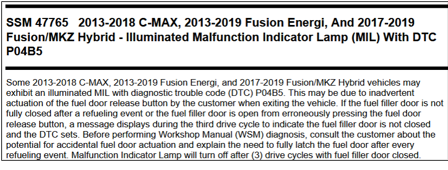
Ford and Lincoln bulletin excerpted from ChiltonLibrary, describing malfunction indicator lamp
(MIL; check engine light) illumination due to fuel door not fully closed.
An illuminated “check engine” light can also mean the oxygen sensor is failing. Replacing it can greatly improve fuel economy:
Fixing a faulty engine sensor can improve gas mileage by as much as 40%.1
2. Check for recalls
Are there recalls for your vehicle? Dealers will repair your vehicle at no charge for most recalls. Some unrepaired recalls affect gas mileage, and more importantly, safety.
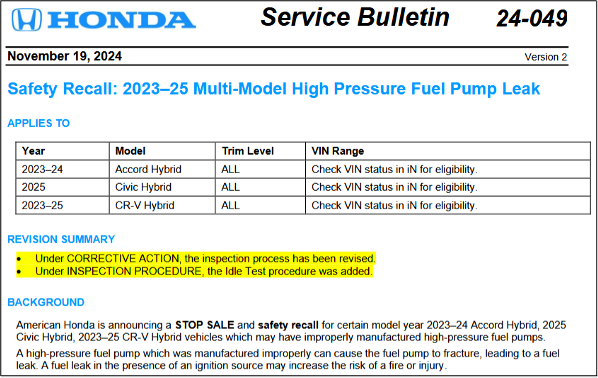
Honda recall bulletin excerpted from ChiltonLibrary, describing fuel leak.
3. Check your tires
As the weight of the vehicle presses down on it, an underinflated tire flattens somewhat, providing a larger surface, or contact patch, against the road. A larger contact patch creates more friction and rolling resistance, requiring more power to move. That’s why underinflated tires can cost drivers more at the pump.
Even a little under inflation makes a difference. According to the Oak Ridge National Laboratory, gas mileage can decrease 0.2% for every psi drop (per tire).2
The National Highway Traffic Safety Administration (NHTSA) reports that
underinflated tires increase fuel costs for 81% of drivers.3
How do tires get underinflated?
Tires are not airtight: small amounts of air constantly escape. Cuts and punctures, such as from road hazards, like potholes and nails, cause bigger leaks. Temperature changes also affect tire pressure. For every 10-degree drop in temperature, tire pressure can decrease about 1 psi.
It can be difficult to see under inflation in modern tires until it is quite low– 12 psi or more.4 So experts recommend drivers regularly check tire inflation with an accurate gauge, and inspect tires for damage. Even for vehicles with a tire pressure management system (TPMS), it is still a good idea to check tire inflation regularly.
How much air should I put in the tires?
Follow the automaker-recommended tire inflation specification. Engineers determine the tire specification by balancing optimal safety with performance, and it is specific to the year-make-model vehicle. Auto manufacturers place the tire specifications placard on the driver’s side doorjamb for most vehicles.
Inflate tires to the automaker specification, not to the numbers on the sidewall of the tire itself. The sidewall maximum pressure stamp indicates the inflation the tire can potentially withstand, and is not for ordinary driving.
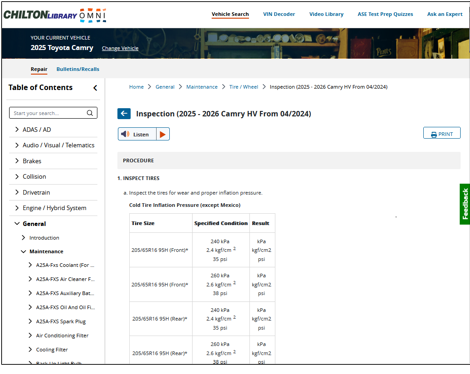
2025 Toyota Camry cold tire inflation pressure specifications, excerpted from ChiltonLibrary.
4. Check the engine oil
Oil protects an engine and allows it to be more efficient by lubricating moving parts, reducing friction, and dissipating heat.
Most vehicles will illuminate a dashboard light to indicate the need for an oil change. Still, it is a good idea to regularly check the oil anyway. Even if it’s a newer car or truck, experts recommend checking the oil every other time you get gas. Check the fluid level if your car has a dipstick, and look for leaks. For those with an EV or hydrogen-fueled vehicle, there is no engine, so no engine oil needed!
When should I change the oil? How much and what type should I use?
Follow the auto manufacturer recommendations in the owner manual or in the ChiltonLibrary knowledge-base. For fuel economy, use the type of oil the automaker specifies for your year, make, and model car or truck.
“Using the recommended grade of motor oil can improve your fuel economy
by 1%-2% if you’ve been using the wrong grade.” 5
5. Travel light
It takes more energy to move a heavier vehicle. Storing heavy or nonessential items in your car or truck reduces gas mileage:
“An extra 100 lbs. in the trunk can decrease fuel economy by 1%” 6
In addition to the extra weight, strapping items outside the vehicle, such as on the roof or on the back, makes the vehicle less aerodynamic, increasing air resistance:
“A large, blunt rooftop cargo box can reduce fuel economy by 2-8% in city driving, 6-17% on the highway, and 10-25% at interstate speeds.”7
6. Drive efficiently
Smooth driving is actually the sweet spot for your vehicle’s engine. Avoid sudden moves like stomping on the gas or brakes. Engines are more efficient with gradual acceleration. Hard braking stresses many components and decreases gas mileage. Using cruise control can improve fuel economy.
“Aggressive driving can lower highway gas mileage by 15-30% and city mileage by 10-40%.” 8
Slow down: Automakers design engines for top efficiency below speeds of 50 mph or more. Driving faster decreases fuel economy, and greater wind resistance adds to that.
“Observe the speed limit. Each 5 mph you drive over 60 mph can reduce your fuel economy by 7%.9
Idling is 0 mpg
Many newer cars will turn off at stoplights or in other situations when the driver might typically idle the engine. If your car or truck doesn’t turn itself off, switch the engine off to improve fuel economy, rather than idle. Check the owner manual and the ChiltonLibrary knowledgebase to learn more about your specific vehicle.
Letting your car idle to warm up doesn’t help your fuel economy: it actually uses more fuel and creates more pollution.” 10
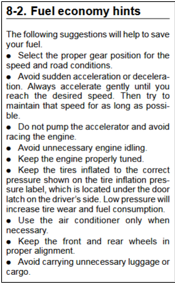
Tips from the 2022 Subaru Forester owner manual, p. 408, excerpted from ChiltonLibrary.
Even small changes can add up to savings at the gas pump. During National Car Care Month and beyond, car owners turn to ChiltonLibrary for factory specifications and step-by-step procedures for individual year-make-model vehicles to maintain and repair their vehicles properly. National Car Care Month is an ideal time to highlight automotive resources. Check out Gale support for ChiltonLibrary.

1 “Fuel Economy: Car Maintenance Tips,” U.S. Department of Energy. www.energy.gov/energysaver/fuel-economy
2 Keeping Your Vehicle in Shape: Keep Tires Properly Inflated,” Oak Ridge National Laboratory for the U.S. Department of Energy and the U.S. Environmental Protection Agency. www.fueleconomy.gov/feg/maintain.jsp
3 “Tires: Maintenance. Save money by taking care of your tires,” U.S. Department of Transportation National Highway Traffic Safety Administration. nhtsa.gov/vehicle-safety/tires
4 “The Pneumatic Tire, Chapter 1, Section 6.1 Maintain Proper Inflation,” p. 26, U.S. Department of Transportation National Highway Traffic Safety Administration, February 2006. https://www.fueleconomy.gov/feg/pdfs/PneumaticTire_HS-810-561.pdf
5 “Save fuel. $ave money. 2026 Fuel Economy Guide: Fuel Economy Saves You Money, Keep your Car in Shape,” p. 6. U.S. Department of Energy, Office of Energy Efficiency and Renewable Energy and U.S. Environmental Protection Agency. www.fueleconomy.gov/feg/pdfs/guides/FEG2026.pdf
6 “Save fuel. $ave money. 2026 Fuel Economy Guide: Fuel Economy Saves You Money, Other Solutions,” p. 6. U.S. Department of Energy, Office of Energy Efficiency and Renewable Energy and U.S. Environmental Protection Agency. www.fueleconomy.gov/feg/pdfs/guides/FEG2026.pdf
7 “Fuel Economy Saves You Money, Other Solutions,” p. 6. www.fueleconomy.gov/feg/pdfs/guides/FEG2026.pdf
8 “Fuel Economy: Driving Tips,” U.S. Department of Energy. www.energy.gov/energysaver/fuel-economy
9 “Save fuel. $ave money. 2026 Fuel Economy Guide: Improve Your Fuel Economy, Drive More Efficiently,” p. 6. U.S. Department of Energy, Office of Energy Efficiency and Renewable Energy and U.S. Environmental Protection Agency. www.fueleconomy.gov/feg/pdfs/guides/FEG2026.pdf
10 Save fuel. $ave money. 2026 Fuel Economy Guide: Fuel Economy Saves You Money, Plan and Combine Trips,” p. 6. U.S. Department of Energy, Office of Energy Efficiency and Renewable Energy and U.S. Environmental Protection Agency. www.fueleconomy.gov/feg/pdfs/guides/FEG2026.pdf