
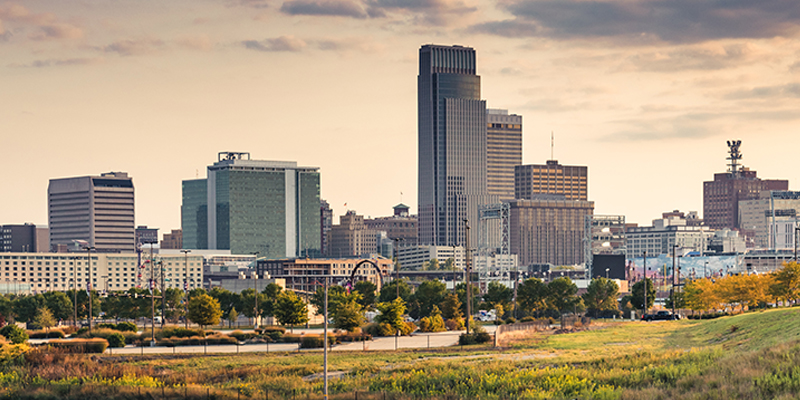
Nebraska might be best known for its sweeping plains and farmland, which make up 90% of the state, but there’s so much more to the Cornhusker State than cows and corn. Take advantage of National Nebraska Day on April 5 to uncover the pioneering Nebraskan spirit. Using Gale In Context: U.S. History, you’ll find resources to introduce students to the state’s prehistoric past, present-day government, famous residents, booming industries, and storied traditions.
Let our National Nebraska Day highlights spark your students’ curiosity—and maybe even encourage them to explore your own state’s history and culture, too! The possibilities are endless with Gale In Context: U.S. History.
Nebraska’s Prehistoric Past
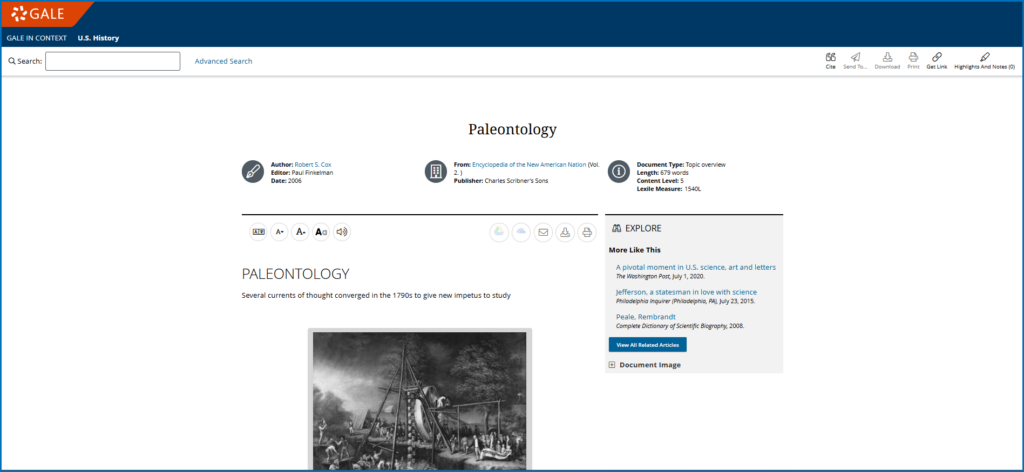
Long before humans arrived in present-day Nebraska, prehistoric creatures—including rhinos and three-toed horses—roamed the land, which we can learn about thanks to the fossils they left behind.
At Ashfall Fossil Beds State Historical Park, paleontologists have discovered an incredible 350 complete skeletons preserved in a fossil bed after a prehistoric volcano erupted in neighboring Iowa. Scientists continue to discover new species and fossils at this site.
Agate Fossil Beds National Monument, located in Harrison, offers another window into Nebraska’s prehistoric past. Its incredible collection of Miocene-era mammal fossils brings ancient creatures and the state’s deep history to life.
You can keep exploring Nebraska’s prehistoric era with help from Gale In Context: U.S. History. The state’s prominence as a leading fossil site can inspire an interesting lesson on paleontology, highlighting how scientists use fossils to learn about the history of life on Earth.
A Brief Historical Overview
Nebraska became the 37th U.S. state in 1867 in the wake of the Civil War. However, Indigenous peoples had already been calling Nebraska home for thousands of years. Let’s take a look at some of the key chapters in the state’s history.
Early History
The state has a rich Indigenous history—even its name, like many other U.S. states, comes from a Native American word. Nebraska means flat water, a tribute to the Platte River that flows through the state. Two tribes—the Pawnee and Arikara—settled in Nebraska early on, establishing villages along the Platte River and other waterways, hunting buffalo, and farming crops such as beans, corn, and squash. Today, several Native American tribes, including the Omaha and Winnebago, continue to call Nebraska home.
European colonization along the Atlantic displaced other Native American tribes, driving them west. Many settled in Nebraska. The Arapaho, Cheyenne, Kansa, and Lakota Sioux were among the tribes that began to call this area home during the 18th century.
The Oregon Trail
During the mid-1800s, an estimated 400,000 settlers and traders followed the Oregon Trail in search of new land and new opportunities. The 2,100-mile-long trail crossed through several territories, including Nebraska. This westward expansion coincided with and contributed to pressures on Nebraska’s Native American tribes, who ceded their land to the United States government between 1833 and 1876.
To this day, Nebraska has many sites that pay tribute to its Oregon Trail history, featuring historic buildings, forts that protected pioneers on the trail, and rock formations that served as landmarks for settlers. Rock Creek Station Historical Park in Fairbury is the site where Wild Bill Hickock, a frontiersman of the American West, began his notorious gun-fighting career.
Modern-Day Legislature
Today, Nebraska has the only unicameral legislature in the country. Rather than a bicameral system with a house of representatives and a senate, Nebraska has a single legislative body composed of 49 senators. Elections in Nebraska are nonpartisan, meaning the ballot does not include the candidate’s political affiliation—another unique facet of the state government.
How does Nebraska’s legislature compare with your own state? Encourage your students to compare the legislative structures. How are they different? In what ways are they similar?
Notable Nebraskans and Their Impact
Bring Nebraska to life in your classroom by exploring the biographies of the standout figures who got their start in the Cornhusker State. Many famous and accomplished individuals hailed from Nebraska, including President Gerald Ford, civil rights leader Malcolm X, and actor and singer Fred Astaire.
Let’s take a look at the lives of two notable Nebraskans: author Willa Cather and investor and philanthropist Warren Buffett.
Willa Cather
Though not born in Nebraska, author Willa Cather (1873–1947) moved to the state at the age of 10. She enrolled at the University of Nebraska at 16, first aspiring to study medicine. However, a professor submitted one of her essays to the Nebraska State Journal, and upon seeing her name published, she shifted her focus to writing.
Throughout her acclaimed career, Cather paid homage to Nebraska in her writing. Her 1897 short story, A Resurrection, took place in Brownsville, Nebraska. In 1913, Cather published her first Nebraska novel, entitled O Pioneers!, which was part of her Prairie Trilogy, along with The Song of the Lark (1915) and My Antonia (1922). Collectively, these books depicted life on the Nebraska frontier. Additionally, Cather’s Pulitzer Prize–winning novel, One of Ours, followed the life of Claude Wheeler, a Nebraska native.
With Gale In Context: U.S. History, Cather’s work can help depict life in the Midwest and the Great Plains at the start of the 20th century.
Warren Buffet
American businessman Warren Buffett was born in Omaha, Nebraska, in 1930—toward the tail end of Cather’s life and career. He earned a Bachelor of Science degree from the University of Nebraska.
In 1965, he took control of the Nebraska-based textile manufacturing company Berkshire Hathaway, beginning his illustrious 60-year career with the company. Under Buffet’s leadership, the company’s stock prices skyrocketed, leading to unprecedented success and helping Buffet become one of the wealthiest men in the world. Known as the Oracle of Omaha, Buffet is a philanthropist who has pledged to donate most of his wealth to charitable organizations.
Using Gale In Context: U.S. History, you can tap into resources about Buffet, his company, and his legacy, including contributions he’s made to the Bill & Melinda Gates Foundation.
The Influence of Agriculture
You don’t have to look far in Nebraska to spot a cow. In fact, there are three times as many cattle as people! Cherry County, Nebraska, is home to 166,000 cows—more than any other county in the nation.
Nebraska’s farms stretch over more than 45 million acres, a patchwork of cornfields, ranches, and wide-open spaces. Agriculture is so important that one out of every four jobs in the state relates to farming. While cattle are key to Nebraska’s agricultural industry, corn—a multi-billion-dollar industry in the state—soybeans, wheat, and potatoes are equally essential crops.
Nebraska-grown corn isn’t just for feeding the cattle—though they do enjoy it! It’s also used to create ethanol biofuel. Nebraska is the second-leading producer of this innovative fuel in the U.S.
Take a closer look at the state’s thriving agriculture industry. Together with your class, you can explore this industry through an economic lens, highlighting the connections between agriculture, the state economy, society, and the environment.
College World Series
Since 1950, Omaha has hosted the NCAA College World Series. The city’s Rosenblatt Stadium, the former host site for the event until 2010, was an iconic symbol for college baseball fans. Omaha has fully embraced its identity as the focal point of college baseball, and the city continues to benefit from this event.
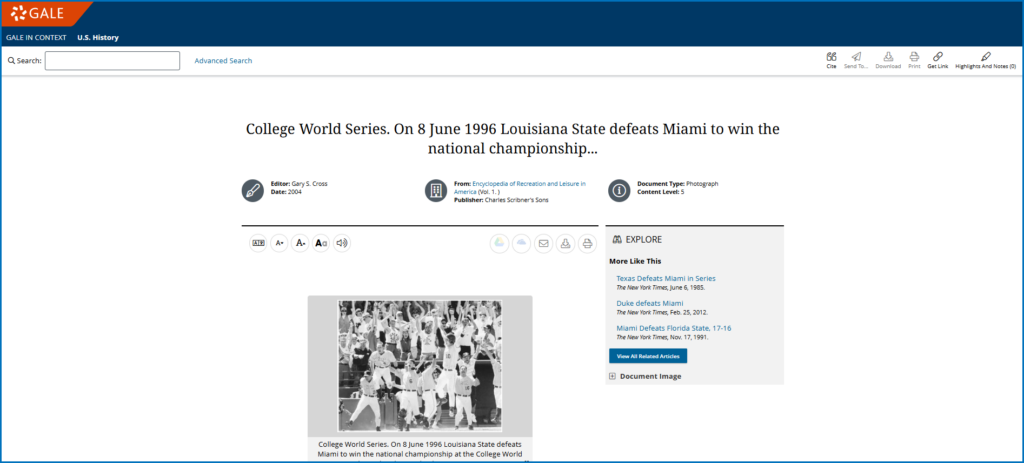
The stadium was named for John Rosenblatt, Omaha native and former collegiate baseball player who became a city council member, and eventually the mayor of Omaha. Rosenblatt convinced the NCAA to bring the College world Series to Omaha, paving the way for the city to become the permanent host of this iconic event in 1950.
Use Gale In Context: U.S. History to explore photos of notable College World Series matchups and read news articles about the event. These resources can inspire thoughtful discussions about what the city of Omaha has gained—both culturally and economically—from hosting this annual event.
Bring State History to Life with Gale
With Gale In Context: U.S. History, it’s easy to turn National Nebraska Day into an interactive learning experience! Gale resources make it easy to engage students with text-to-speech tools, adjustable font sizes, translation tools, and a wide range of multimedia resources.
But there’s so much more to explore! Use Gale In Context: U.S. History to dive into the other 49 states. Not yet a subscriber? Contact your local representative today!