

On January 3, J.R.R. Tolkien’s birthday, The Tolkien Society and Middle-earth fans everywhere raise a glass to the literary giant affectionately known as “The Professor.” Best known for writing The Hobbit and The Lord of the Rings, Tolkien is widely regarded as the father of modern fantasy. His creation of Middle-earth and his invented languages, including Elvish, served as inspiration for these works, which garnered international praise and inspired award-winning movies and television series, still in production today.
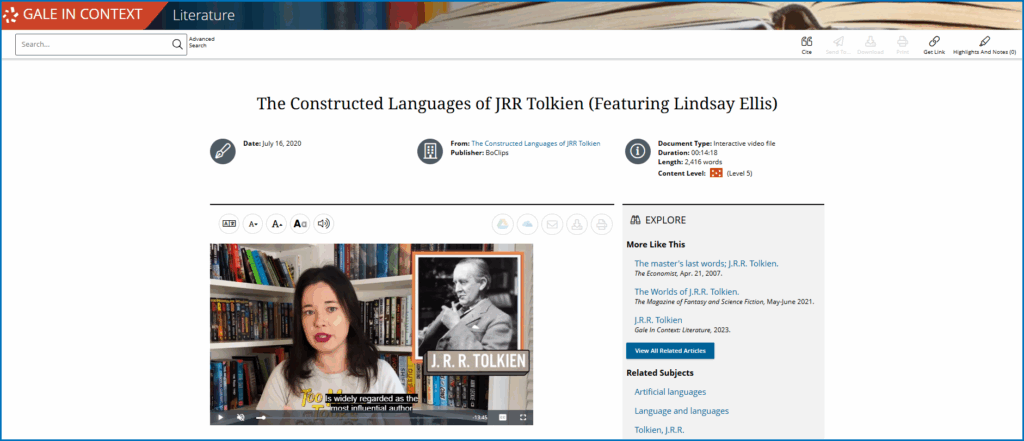
Tolkien’s literary output was tremendous, and there’s a lot of ground to cover. But integrating Tolkien into the high school classroom doesn’t have to feel as daunting as Frodo’s journey into Mordor.
With Gale In Context: Literature, educators can guide students in unpacking and analyzing Tolkien’s literary masterpieces using plot and character summaries, videos, images, and more. Our accessibility tools—including text-to-speech options, adjustable font sizes, and translation tools—ensure that all students can engage with the content, helping them better understand Tolkien, his works, and his lasting influence on the fantasy genre.
Let’s explore Tolkien’s life and literary masterpieces and discover resources to help you develop engaging lessons on Tolkien for your classroom.
Tolkien’s Early Life
John Ronald Reuel Tolkien (1892–1973) was a British author and scholar, born in South Africa to English parents, Arthur and Mabel.
At the age of three, Tolkien traveled to England on what had been intended as a visit, rather than a permanent relocation. Tragedy struck, however, and his father died of rheumatic fever before he could join his family in England.
Following the death of her husband, Mabel remained in England to be closer to family—but after converting to Catholicism, she lost their support. She died from diabetes at the age of 34, leaving Tolkien and his brother, Hilary, in the care of the local parish priest, Father Francis Morgan.
As a teenager, Tolkien showed a keen interest in linguistics. He learned Latin and Greek, common among students at the time, as well as more obscure languages, such as Gothic and Finnish. Tolkien took his love of linguistics even further, inventing his own languages and, in turn, his own world. Together with his friends, Tolkien founded the Tea Club, Barrovian Society, better known as TCBS, a secret group that discussed literature, language, and mythology.
Education and World War I
During his studies at Exeter College at Oxford, Tolkien created Middle-earth, a fictional world that would later become the setting for The Lord of the Rings trilogy.
Tolkien graduated from university and enrolled in the military during the height of World War I. He enlisted with the British Army’s Lancashire Fusiliers and eventually faced active duty on the Western Front. However, just four months later, he caught trench fever, an illness that left him hospitalized for a month. Despite recurrences of the disease throughout the war, he worked his way up to the rank of lieutenant.
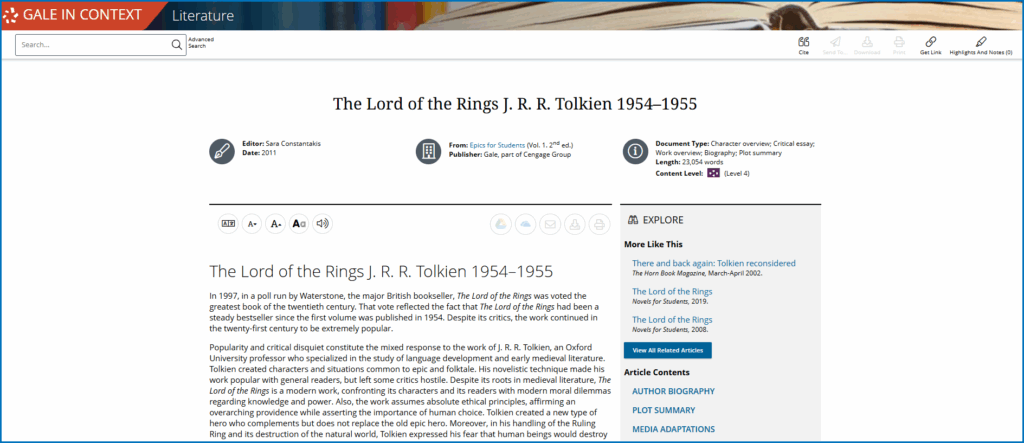
Sadly, Tolkien lost many of his close friends during the war, and these losses, along with his war experiences, served as inspiration for some of his early writings. For example, his Book of Lost Tales details images of war that Tolkien saw firsthand, and The Lord of the Rings paid tribute to two of his close friends, Robert Gilson and Geoffrey Smith, who died in the war.
Academic Career
Following his military service, Tolkien began his professional life as an assistant lexicographer at the New English Dictionary, before then spending five years as a professor of English at the University of Leeds. In 1925, a job vacancy at Oxford University opened the way for his return to his alma mater, now as professor of Anglo-Saxon (Old English).
While working in academia, Tolkien composed several works, including a translation of the late medieval Arthurian poem Sir Gawain and the Green Knight, in collaboration with his “devoted friend and pal” E. V. Gordon. At this time, he also invented Elvish, a language inspired by Welsh and Finnish, which contained several different dialects.
Tolkien’s Writings
Tolkien published The Hobbit in 1937, first introducing readers to Middle-earth. It was a critical and financial success, leading his publisher to request a sequel. Tolkien started writing The Lord of the Rings as a single-volume follow-up to The Hobbit, but it took on a darker tone and far more epic proportions than his previous book. He published the first volume, The Fellowship of the Ring, in 1954, followed by subsequent volumes, The Two Towers (1954) and The Return of the King (1955).
Like The Hobbit, The Lord of the Rings trilogy received much critical acclaim, selling 150 million copies worldwide. In 1997, British-based Waterstones Bookstore named it the best book of the 20th century.
A Literary Friendship
Throughout his career, Tolkien was friends with fellow fantasy author C. S. Lewis. The two men shared a love of languages, storytelling, and fantasy, reflected in both authors’ notable works, including Tolkien’s The Hobbit and Lewis’s The Chronicles of Narnia.
Their similarities extended beyond their shared love of literature—both men lost their parents at a young age and fought in World War I. These shared connections bonded Tolkien and Lewis, creating a remarkable and long-lasting friendship. Together, Tolkien and Lewis founded The Inklings, a literary discussion group at Oxford where authors gathered to read and critique their work, reminiscent of TCBS, his childhood group.
Impact on Pop Culture and Legacy
Still today, Tolkien’s legacy lives on. Director Peter Jackson transformed The Lord of the Rings trilogy into three award-winning films released between 2001 and 2003. The Return of the King won an historic 11 Academy Awards—the first film to win every category in which it received a nomination.
In 2022, Prime Video released the first season of The Rings of Power, an epic drama set in the second age of Middle-earth, thousands of years before The Hobbit and The Lord of the Rings. Finally, The Hunt for Gollum, a new Lord of the Rings movie, is set for release in 2027.
Tolkien’s works have also inspired musicians, including Led Zeppelin, whose songs “Ramble On” and “The Battle of Evermore” include Middle-earth references to Mordor, Gollum, and the Dark Lord, Sauron. In 1970, Swedish musician Bo Hansson released a progressive rock album entitled Music Inspired by The Lord of the Rings. World-renowned Irish musician Enya released an instrumental song, “Lothlorien,” in 1991 and later performed on the soundtrack of The Fellowship of the Ring—in English and Elvish.
After Tolkien’s death, his son Christopher dedicated much of his life to preserving his father’s work, releasing such unpublished books as Unfinished Tales of Númenor and Middle-earth (1980); The History of Middle-earth, a 12-volume series published between 1983 and 1996; and The Book of Lost Tales (1983).
Keep Exploring Middle-earth With Gale In Context
With Gale In Context: Literature, students can explore all things Middle-earth, from Tolkien’s real-world inspirations and in-depth backstory to the legacy of “The Professor.” Plus, you can dive into the legend of King Arthur and Sir Gawain and the Green Knight, or study more recent fantasy works that carry Tolkien’s influence, including J.K. Rowling’s Harry Potter series.
If you’re not already accessing the benefits of Gale In Context: Literature, contact your local representative today!