
|By Gale Staff|
On April 9, 1917, 100,000 Canadian troops stormed Vimy Ridge, a heavily defended German position in northern France. After three days of grueling fighting, Canadian troops succeeded where British and French forces had failed, and took back the ridge.
More than just a military success, the Battle of Vimy Ridge represented the sacrifice, bravery, and resilience of the Canadian spirit—and marked a defining moment in the country’s history. Today, Canadians honor these brave men every April 9 with Vimy Ridge Day, which includes ceremonies in Canada, and at the battlefield memorial in France.
With a little help from Gale In Context: Canada, the Battle of Vimy Ridge can inspire an engaging history lesson. Students can explore the battle—including its context, key players, and legacy—using rich text, audio, and video resources. Our suite of industry-leading accessibility features (text-to-speech options, adjustable font size, and translation tools) invites full participation from students of all learning styles and preferences. Gale In Context: Canada also offers French-language content, making it ideal for French language classrooms as well.
Vimy Ridge: A Victory for Canada
With Gale In Context: Canada, educators can situate Vimy Ridge within the events of World War I and the broader context of Canadian history. Below, we’ll turn to Gale’s wealth of primary and secondary sources, including images and videos about the war. Join us as we open this momentous chapter in Canadian history.
Canada’s Role in World War I
Unlike the United States, which had fought to gain its independence during the Revolutionary War, Canada retained its ties to Britain. In fact, many British loyalists fled the United States for Canada.

It wasn’t until July 1, 1867—recognized today as Canada Day—that the nation confederated, with the province of Canada (consisting of present-day Ontario and Quebec) joining together with New Brunswick and Nova Scotia. Although Canada had become a self-governing in domestic matters, it was still a British dominion. As a result, when Britain declared war on Germany in 1914, Canada entered the war immediately and unconditionally.
By contrast, the U.S. was hesitant to become involved. Canada’s neighbor to the south didn’t enter the war until April 1917—the same month that Canadian forces took Vimy Ridge back from the Germans. When the U.S. finally joined the war alongside the Allied Forces, it retained full control over military forces, whereas Canada’s troops fought under the British command structure.
The Value of Vimy Ridge
Vimy Ridge was a geographically significant and strategically important location in northern France near the town of Arras. Its elevation provided a strong defensive position, giving troops an excellent vantage point of the land below. As a result, Vimy Ridge was the site of ongoing battles as the Allies sought to take the land from the Germans, who had occupied it since early in the war. However, previous attempts had failed and led to significant casualties. More than 150,000 French and British soldiers had fallen at Vimy Ridge.
By 1917, the Western Front saw both sides locked in trench warfare. Despite repeated failed attempts to take Vimy Ridge, the area remained in the Allied Forces’ sights—this time, with Canada leading the charge.
Significance for Canada
Canada’s victory in Vimy Ridge was remarkable. Not only did Canada succeed where other Allied Forces had failed, it was also the first time that all four Canadian divisions fought as a unified force. Led by Commander Lieutenant-General Sir Julian Byng, it was a bold and defining moment in Canadian history.
The Canadians spent months planning the attack, executing detailed rehearsals and digging an extensive system of tunnels under German lines so that troops could move safely away from enemy fire. This tunnel system included huge underground bunkers where troops stockpiled supplies and weapons for easy access during the battle. Innovative artillery plans maximized their chances of success, with specialized roles including machine gunners that provided cover, riflemen that advanced to secure ground, and grenade throwers that cleared enemy trenches.
Perhaps the most significant tactical innovation to emerge from Vimy Ridge was the rolling (or creeping) barrage. This maneuver involved bombarding a battlefield in short, timed increments with troops advancing closely behind the initial barrage, often only 90 meters away. As the Germans waited for the barrage to pass, Canadian forces swept in behind leaving the Germans cornered. Canadian forces succeeded where other Allied forces had failed because of this meticulous planning and reconnaissance, the development of specialized roles, and their tactical innovation.
Canada’s success at Vimy Ridge was unprecedented. This triumph elevated Canada’s reputation on an international stage, establishing the nation as a key player alongside Allied forces. It also allowed Allied troops to continue to weaken German forces in northern France, so troops could move freely through Vimy Ridge. Canadian and British troops made additional gains just a few weeks later, winning the Second Battle of Arleux in late April, further weakening key German defenses.
Continue exploring key moments in Canadian history by using resources from Gale In Context: Canada to examine the country’s role in World Wars I and II.
A Part of Canada’s National Identity
The victory at Vimy Ridge is a powerful symbol of Canada acting as a unified nation in World War I. It served as a symbolic marker of Canada transitioning from a British colony to its own nation—further reinforced by Canada’s role as an independent signatory at the Treaty of Versailles and obtaining its own seat at the League of Nations.
A Memorial to Canada’s Fallen Troops
The Canadian victory at Vimy Ridge came at a high cost. During the three-day battle, Canadian forces sustained heavy casualties, including 3,598 troops killed and another 7,000 wounded.
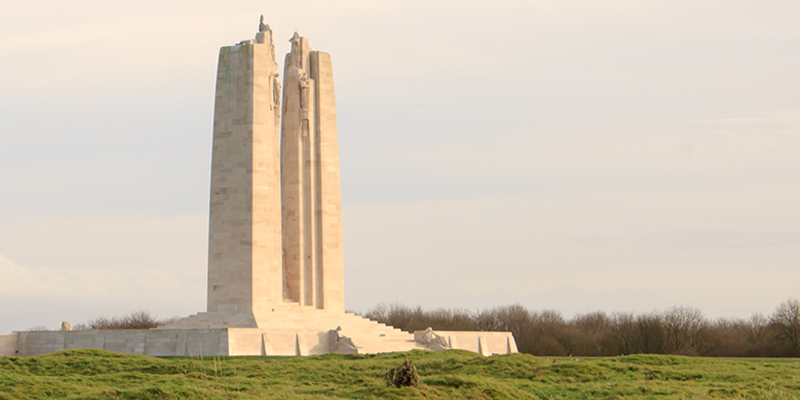
To show their gratitude, France gifted 250 acres on Vimy Ridge to Canada for “a monument commemorating the exploits of Canadian soldiers in the great war.” Today, the Vimy Memorial, located at the site of the battle, pays tribute to those who fought and remembers their sacrifice.
Remember Vimy Ridge in the Classroom
John Babcock, Canada’s last World War I combat veteran passed, away in 2010 at the age of 109. With the passing of this generation, it’s more important than ever that we keep their memory alive: their bravery, innovation, and love for Canada. With Gale In Context: Canada, students can understand the battle of Vimy Ridge, the wider context in which these men fought, and the legacy of their sacrifice.
Contact your Gale representative today to gain access to Gale In Context: Canada and introduce your students to its wealth of resources about Canadian history.