
|By J. Robert Parks|
The oft-told story of computer inventors and entrepreneurs building the first wave of companies in their garages is not a myth. Steve Jobs really did help manufacture the first Apple I computers in his father’s garage. But people’s reliance on that narrative often reinforces the idea of the singular genius—a very popular American trope—and overlooks all that goes into any company’s success. For example, December 8, 2025 marks the fiftieth anniversary of the opening of Byte Shop in 1975, the world’s first computer store and a key contributor to Apple’s early success. Educators and librarians looking to broaden students’ perspectives on how personal computers became one of the most important inventions of the late twentieth century will find a wealth of information in Gale In Context: U.S. History.
The history of computers in the twentieth century is a story of steady advancement made possible by brilliant engineers, pioneering companies, and some key moments of government assistance. That steady advancement involved integrated circuits. Computer chips then started becoming progressively smaller, even as they grew more powerful. However, even in the 1960s, the idea that people might have a personal computer on their desk anytime soon seemed far-fetched.
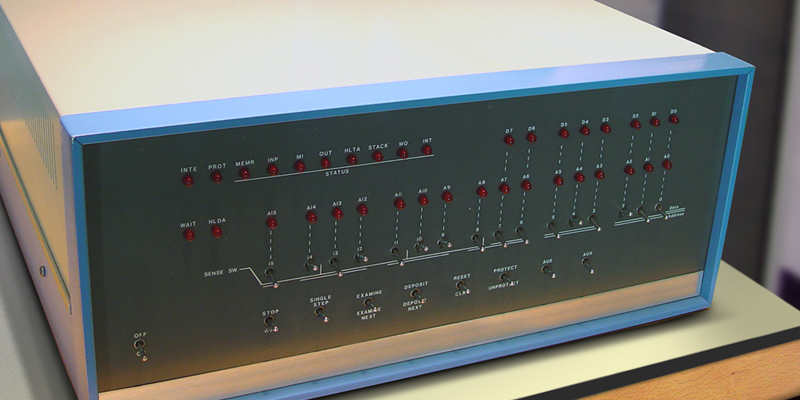
Today, people wouldn’t recognize those first home computers. The Altair 8800, which came out in 1974 and is often considered the first personal computer, was simply a processing chip that powered a box with switches and lights. A user could flip the switches, and the lights would turn on and off. The whole thing had 256 bytes of memory. Not 256 megabytes. Not 256 kilobytes. Just 256 bytes.
In 1975, Steve Wozniak began developing his own computer—extremely primitive by today’s standards. This computer was simply a circuit board that could be connected to a video monitor and keyboard, but it was also the first example where someone could type on a personal computer and see what showed up on their screen. Wozniak was smart enough to design it so that it could interface with a television set. Wozniak was friends with Steve Jobs, and they founded Apple the following year.
Byte Shop was founded a few months prior by Paul Terrell and Boyd Wilson in Mountain View, California, in the middle of what is now referred to as Silicon Valley. The store initially sold books, magazines, hardware, and software for people starting to experiment with what were called microcomputers (the store’s name came from a microcomputer magazine that had started a few months before). Byte Shop’s contribution to Apple’s story, and the story of personal computers, is two-fold. One is that it was the first store to place an order for Wozniak’s computer, known as an Apple I. Terrell, who had seen Jobs and Wozniak give a demonstration at a computer club, said he’d order 50 of the computers and pay $500 for each. The second contribution is that Terrell demanded the computer be fully assembled. Jobs and Wozniak initially planned just to sell the greenish circuit board, but Terrell knew that it needed to be more constructed than that.
With the support of Byte Shop, Apple sold 150 computers in 1976. That gave the company enough capital and visibility to produce the Apple II, also developed by Wozniak and released in 1977. Its debut at the West Coast Computer Faire set the personal computing world on fire. Wozniak would soon develop a floppy disk drive and disk that could store large amounts of data (well, slightly more than 100 kilobytes), enabling personal computer users to save their work easily. The personal computer revolution was underway, and early companies such as Commodore and Tandy came out with their own models, followed by IBM in 1981.
It’s easy for students today to assume that Apple and Steve Jobs have always been successful. However, the company’s history in the 1980s was so rocky that Jobs was forced to resign in 1985. The company struggled to keep up with the rise of Microsoft and personal computers that ran its Windows software. Jobs only returned in 1997 when Apple was at its lowest, and it was only the release of the iPod in 2001 that gave Apple the financial stability to develop and launch the iPhone six years later.