
By: Sara Tarpley, Director Academic Engagement
This third installment of the acclaimed Eighteenth Century Collections Online series brings researchers 1.7 million never-before-digitized pages, including a variety of historical archives in unusual formats and sizes like broadsides, maps, and full-color book covers and spines. Expand eighteenth-century studies for researchers across disciplines to explore global perspectives from the 1700s in Europe, the Americas, Asia, and Australia.
Whenever I talk with librarians and faculty about the long eighteenth century, I’m reminded of just how deeply Eighteenth Century Collections Online has shaped the field. ECCO has been part of the scholarly infrastructure for so long that many of us don’t remember a time when we couldn’t keyword‑search our way through the century. It’s changed syllabi, changed dissertations, and changed the kinds of questions people even think to ask.
But it’s also true that digitization priorities have evolved. Scholars—and librarians especially—have spent years telling us what they still need: materiality, ephemera, color, and better ways to surface voices that were always part of the eighteenth century but rarely part of its digital record.
ECCO III Is Our Response to That Feedback
And it opens up a side of the period that earlier microfilm workflows simply couldn’t capture.
But before getting into the details, I want to start with the framing question that shaped this project for me: What if the eighteenth century had social media? Stay with me—because once you see it, you can’t unsee it:
The Eighteenth Century Already Behaved Like a Social Platform
When we imagine our modern digital habits—breaking news, influencers, viral content—we tend to think of them as uniquely contemporary phenomena. But if you’ve spent any time with eighteenth‑century print, you know better.
The energy is the same.
The speed is the same.
The public performativity is the same.
It’s the technology that’s different.
ECCO III finally brings those parallels into focus by restoring the formats that represented the “lived media environment” of the period.
Broadsides = Breaking News
Broadsides were the eighteenth century’s push notifications: plastered across city streets, announcing battles, executions, scandals, elections—anything meant to be consumed quickly and emotionally. Their typography was bold, dramatic, and absolutely intended to go viral by eighteenth‑century standards.
Ballad Sheets = Short‑Form Video Culture
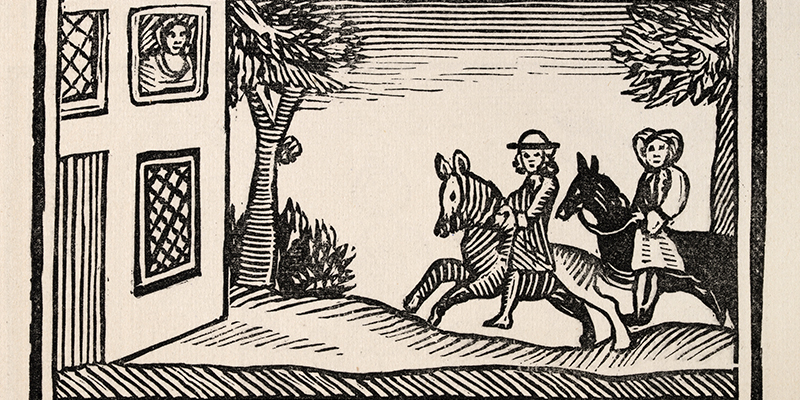
Ballad sheets—often with woodcut illustrations—were the period’s visual media. They told sensational stories, political gossip, and romantic drama in formats designed to be remembered, repeated, and performed aloud. Think TikTok, but with more wigs and fewer copyright lawyers.
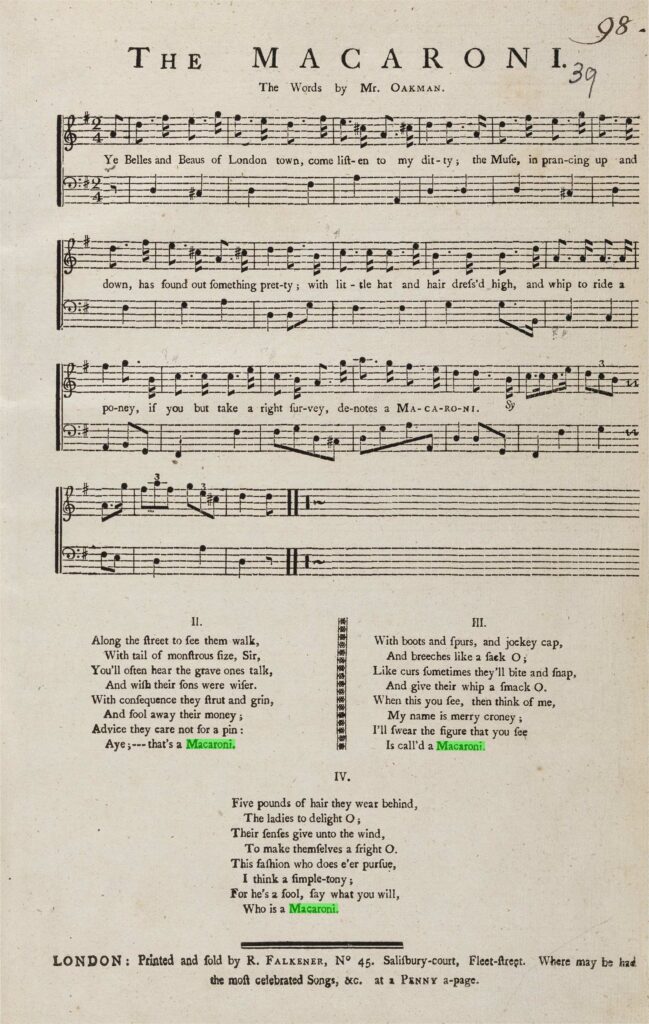
Oakman, John. The macaroni. The words by Mr. Oakman. Printed and sold by R. Falkener, [1770?]. Eighteenth Century Collections Online.
Note: For researchers, items like this song are invaluable for understanding eighteenth‑century performance culture, urban sociability, satire, and the intersection of fashion and politics.
Pamphlets = Hot Takes
Pamphlets were printed fast. Sometimes within days. This is the eighteenth century’s rapid‑response discourse—opinion pieces, satire, rebuttals, all appearing at the blistering pace of a scandal unfolding in real time.
Macaronis = Influencers
If you don’t know the macaronis, imagine a mashup of fashion influencers and internet micro celebrities: flamboyant, trendsetting, endlessly gossiped about. They were caricatured, satirized, adored, and mocked—exactly the cycle of online visibility we see today.
These aren’t just cute parallels—they’re historically meaningful.
And ECCO III captures the formats and aesthetics that make those connections visible.
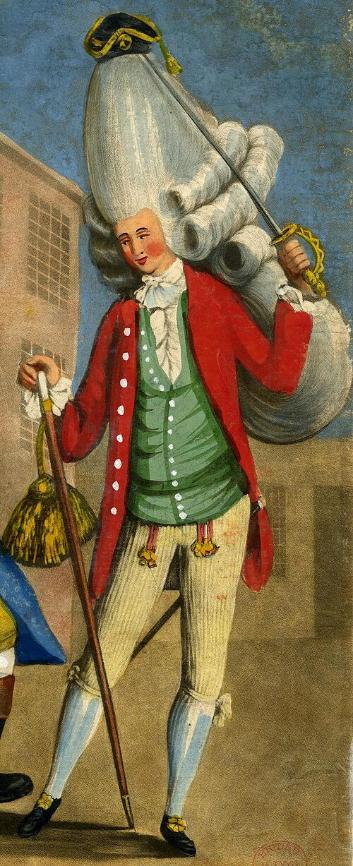
Image of a Macaroni
Beyond Text: Why Materiality Needed to Come Back into the Picture
ECCO I and II did extraordinary work in making eighteenth‑century text accessible, but microfilm brought tradeoffs. Covers were excluded. Spines were excluded. Foldouts, texture, color, binding styles—gone.
And for many research questions today, those aren’t extras. They’re essential.
With ECCO III, we restore:
- covers and spines
- bindings and endpapers
- marginalia
- ownership markings
- inserted illustrations
- physical evidence of use
These features matter for book history, provenance research, print culture, and archival studies. They also matter for teaching. Students respond differently—more thoughtfully—when the materiality is visible.
One of my favorite examples: tiny books.
They’re adorable, yes, but also deeply revealing about intimacy and portability in reading practices. They also challenged our imaging team enough that the British Library invented a custom book cradle just to capture them properly. (It opens at 90 degrees and includes a clear strap—ingenious!)
Color Transforms Scholarship—and Student Engagement
I always say: color isn’t a luxury. It’s a research tool.
Especially for:
- natural history
- scientific illustration
- art and aesthetics
- cartography
- studies of pigment and print technique
When we show natural history faculty side‑by‑sides of microfilm vs. ECCO III color images, their eyes light up. You can see details, lines, shading, and accuracy that were entirely invisible before.
And students?
Color immediately changes their sense of what “the eighteenth century” looked and felt like. It’s one of the most effective teaching enhancements we’ve made.
Metadata That Supports Today’s Research Questions
ECCO III includes new metadata—developed with great care and a lot of expert review—designed to help researchers ask better, more inclusive questions.
This includes:
- validated author gender metadata
- modern standardized country names for publication place
- more consistent format and size descriptions
These fields help surface voices that were harder to find in earlier digital environments, particularly women writers. ECCO III adds over 1,500 works by women, and gender metadata makes it far easier to explore authorship patterns and representation in informed, responsible ways.
ECCO III + Digital Humanities = A More Complete Research Ecosystem
ECCO I and II will always be crucial for text mining and computational methods. ECCO III doesn’t replace that—it complements it.
Together, the three parts support:
- distant reading
- close reading
- visual and object‑based analysis
- multimodal digital humanities work
This is where the field is heading: integrating text, image, materiality, and metadata to form a full picture of the eighteenth century.
Why ECCO III Matters for Libraries and Scholars
ECCO III strengthens:
- material culture and book‑history work
- special collections adjacent teaching
- interdisciplinary humanities research
- digital scholarship using visual and paratextual methods
- student engagement with primary sources
And honestly?
It also makes the eighteenth century fun again. Not trivial or unserious—just vibrant, human, and recognizably social.
ECCO III doesn’t just fill gaps.
It changes the feel of the archive.
It restores dynamism, diversity, and the everyday voices that shaped the period every bit as much as canonical texts did.