
| By Volume Editor J.Alexander Ogden |
Gale, a division of Cengage, has just released its latest content set as part of its award-winning Dictionary of Literary Biography (DLB) series, which is now part of Gale Literature Resource Center. The content, which is the first in a two-part set, comprises more than 30 in-depth biographies of notable authors from Ukraine and Belarus, many of which have been written by scholars in those countries.
Researching and writing a reference entry during wartime presents certain challenges; one of several Ukraine-based contributors noted, “It was a time of drone and missile attacks and power outages up to 18 hours a day.” Writers persevered despite difficulties, making available resources on major writers from two literary traditions that have recently drawn increased attention worldwide. With Svetlana Alexievich’s Nobel Prize for Literature in 2015 and books by Ukrainian authors, including Andrey Kurkov and Oksana Zabuzhko, seeing immediate translation into English, anglophone readers have started to discover the breadth and depth of these traditions.
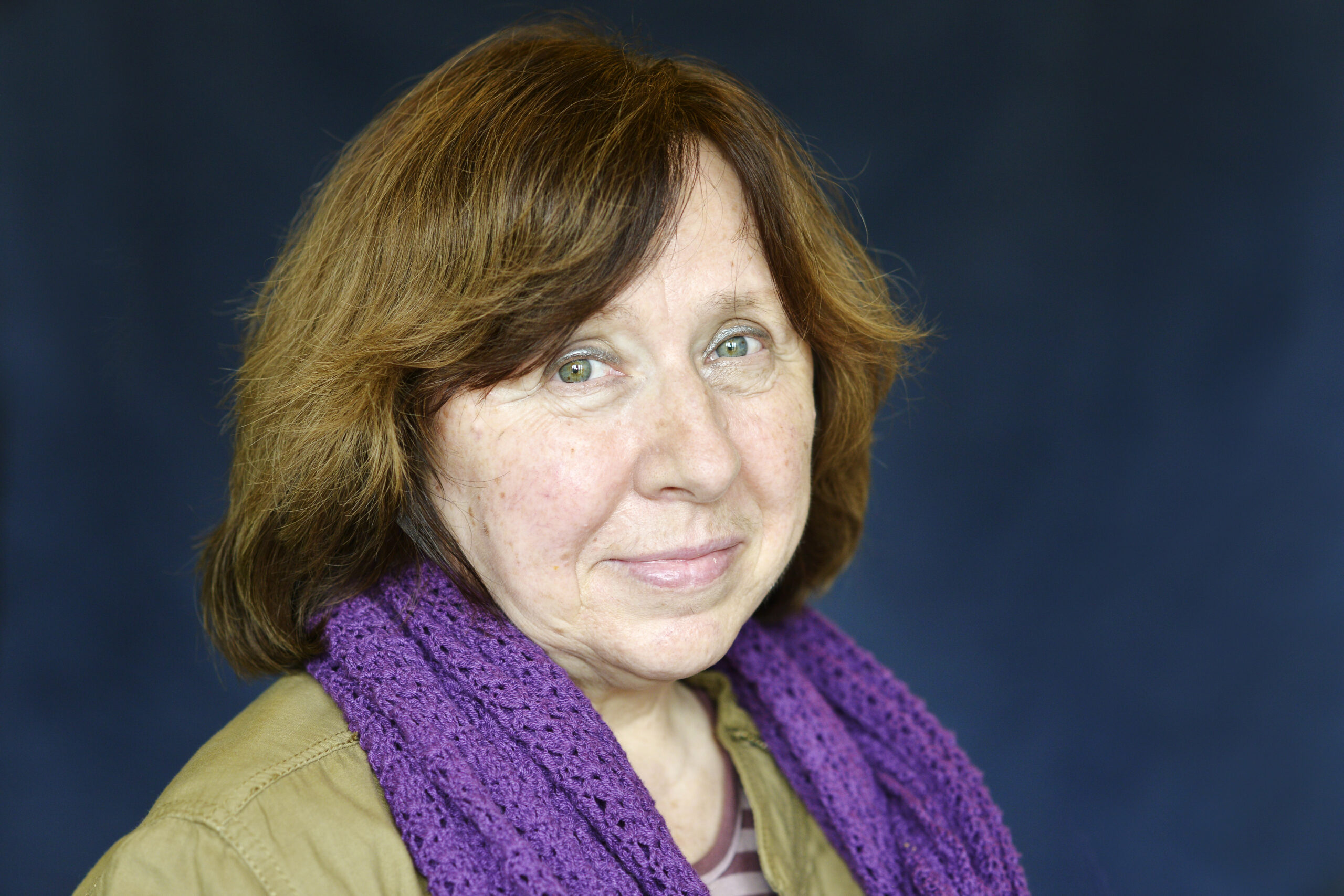
Nobel Prize-winning Belarusian author Svetlana Alexievich (1948–)
The ongoing war in Ukraine and mass protests in Belarus are familiar from the headlines, and some entries in this new collection capture the conflict with passion and immediacy. Writer and band frontman Serhii Zhadan enlisted in the National Guard of Ukraine, and poet Oleksandr Irvanetsʹ and his partner crossed the Irpin River on wooden planks under bombardment. Irvanetsʹ wrote, “From a city destroyed by rockets / I will scream to the whole world.”

Ukrainian writer Serhii Zhadan (1974–), who is currently in the National Guard serving in Ukraine’s war with Russia.
This latest addition to the DLB adds to an impressive body of in-depth studies of the world’s most significant writers, while taking advantage of the latest advances in digital access and database technology. Gale’s DLB series—currently numbering nearly 400 volumes—has been the gold standard in literary biography for nearly 50 years, covering world writers in much greater detail than other reference sources, including full bibliographies and a biographical essay on each writer. Recently, the series evolved to fully digital status—this is the third such collection—making all the entries easily searchable exclusively in Gale Literature Resource Center. Additional features for enhanced navigation include a multilevel table of contents and a “More in the Collection” section.
Ukrainian and Belarusian Writers presents 31 biographies spanning centuries and styles, so that the entries selected give a deep sense of the cultural heritage of both nations. The roots of both traditions reach back to the Middle Ages and grew through the contributions of major humanists of European-wide significance, including Francysk Skaryna in the sixteenth century and Hryhorii Skovoroda in the eighteenth. But it was a freely imagined burlesque version of The Aeneid transforming Vergil’s characters into Cossacks and petty officials—Ivan Kotliarevsʹkyi’s Eneïda at the end of the eighteenth century—that jump-started a modern Ukrainian literature through its use of vernacular and dialect. By the mid-nineteenth century, Ukrainian was a full-fledged literary language; modern Belarusian literature emerged roughly a half century later, gaining steam in the late nineteenth century and flourishing by the early twentieth.
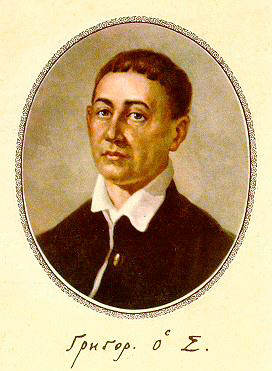
Hryhorii Skovoroda (1722–1794), who is considered the last and best-known representative of early-modern Ukrainian culture.
Nineteenth-century origins—coinciding with a romantic interest in folklore and local distinctiveness—meant that much classic literature drew on folk genres. This included the work of “national poets” Taras Shevchenko of Ukraine and Ianka Kupala of Belarus. In many cases, these writers were not only foundational figures in a national literary tradition but also key in establishing flexible modern literary languages for those traditions. In the nineteenth century, the choice to write in an emerging literary language instead of a dominant one, such as Russian, German, Polish, or Yiddish, was bound up with celebrating a distinct national identity and giving expression to the vibrant colloquial language of the people.
Writers were at the forefront of philosophy, scholarship, and movements for nation self-determination. Ivan Franko, for example, was a protean figure. As a writer, critic, and public intellectual, he knew 19 languages, held a Ph.D., was an expert in multiple academic disciplines, and was nominated for a Nobel Prize in 1916. As noted in the entry, he was called an “academy in one person” and a “Ukrainian Moses.” Olʹha Kobyliansʹka wrote her first works in German, under the influence of Goethe, Heine, and Schiller, before switching to Ukrainian and introducing a range of Western ideas—from Social Darwinism to feminism—into Ukrainian culture. In this voracious reading and avid creative engagement with ideas from elsewhere, Kobyliansʹka was not alone: Ukrainian and Belarusian Writers demonstrates influences on the region’s literature that range from ancient Greek and Roman authors to the Beat poets and the Sex Pistols. Ukraine and Belarus—the latter the homeland of Marc Chagall—are also perhaps surprising as major contributors to literary modernism.
Seeing a region too often treated by Western historians and politicians as a hinterland as, instead, the heartland and center of gravity of Europe—a historical crossroads for the meeting of empires, identities, languages, and ideas—provides an invigorating fresh perspective on European culture in keeping with recent pathbreaking work by Yale historian and public intellectual Timothy Snyder and historian and journalist Anne Applebaum. Snyder’s work, as seen for example in Bloodlands,a study of Nazi and Soviet tragedies, also makes clear the difficult history of the region. Alexievich’s “documentary histories”—which earned her the Nobel Prize for Literature—deal with such difficult topics as the legacy of the Chornobyl disaster, the Soviet war in Afghanistan, and the experience of women and children in World War II. Alexievich views her primary mentor as fellow Belarusian writer Alesʹ Adamovich, whose own work confronted central tragedies of twentieth-century Belarusian history, including the Khatyn massacre and Chornobyl (also spelled Chernobyl). Yet these writers collectively also provide proof of resilience and tenacious hope in the face of adversity. Zmitrok Biadulia, a Jewish writer who lived through the transition of his region from a center of the Tsarist Pale of Settlement to the epicenter of Hitler’s Final Solution, wrote the first Belarusian-Yiddish dictionary and published a largely optimistic book on Belarusian-Jewish relations over the centuries.
English-speaking readers and researchers are beginning to uncover the wealth of these two literary traditions, but authoritative English-language scholarship on them lags behind the coverage of larger European literatures. In the case of many of the writers included, the entries provided in this collection offer the most extensive and rigorous work on them available in English—even in the case of writers who have won major European literary awards and been translated into multiple languages. The collection fills a gap and will encourage further scholarship.
About the Author
J.Alexander Ogden holds a doctorate in Slavic languages and literatures from Stanford University. His research focuses on reflections of peasant voices and folk traditions in literature and on theoretical issues of stylization and self-fashioning. He is an editor of three volumes of the Dictionary of Literary Biography.